Neural Architecture Search with Actor-Critic Learning for Energy Forecasting
An innovative NAS framework using Actor-Critic reinforcement learning to automatically discover optimal neural architectures for energy time series forecasting, featuring advanced attention mechanisms and LSTM-based policy networks.
Challenge
Long-term time series forecasting (LTSF) in energy markets presents unique challenges that traditional approaches struggle to address. While different generations of forecasting models exist, each has limitations. The industry needs an automated way to combine the strengths of various approaches while mitigating their individual weaknesses.
Solution
I developed a sophisticated Neural Architecture Search framework using an Actor-Critic reinforcement learning approach. The system automatically discovers optimal combinations of different forecasting models, attention mechanisms, and temporal components. The framework employs a shared LSTM layer for architecture sampling and includes a comprehensive search space covering multiple model generations.
Impact
The framework achieves significant improvements in forecasting accuracy while automating the architecture design process. Key metrics include: • Automated discovery of optimal model ensembles • Efficient exploration of vast architecture search spaces • Adaptive combination of different forecasting approaches • Scalable evaluation across multiple energy datasets
Actor-Critic Architecture
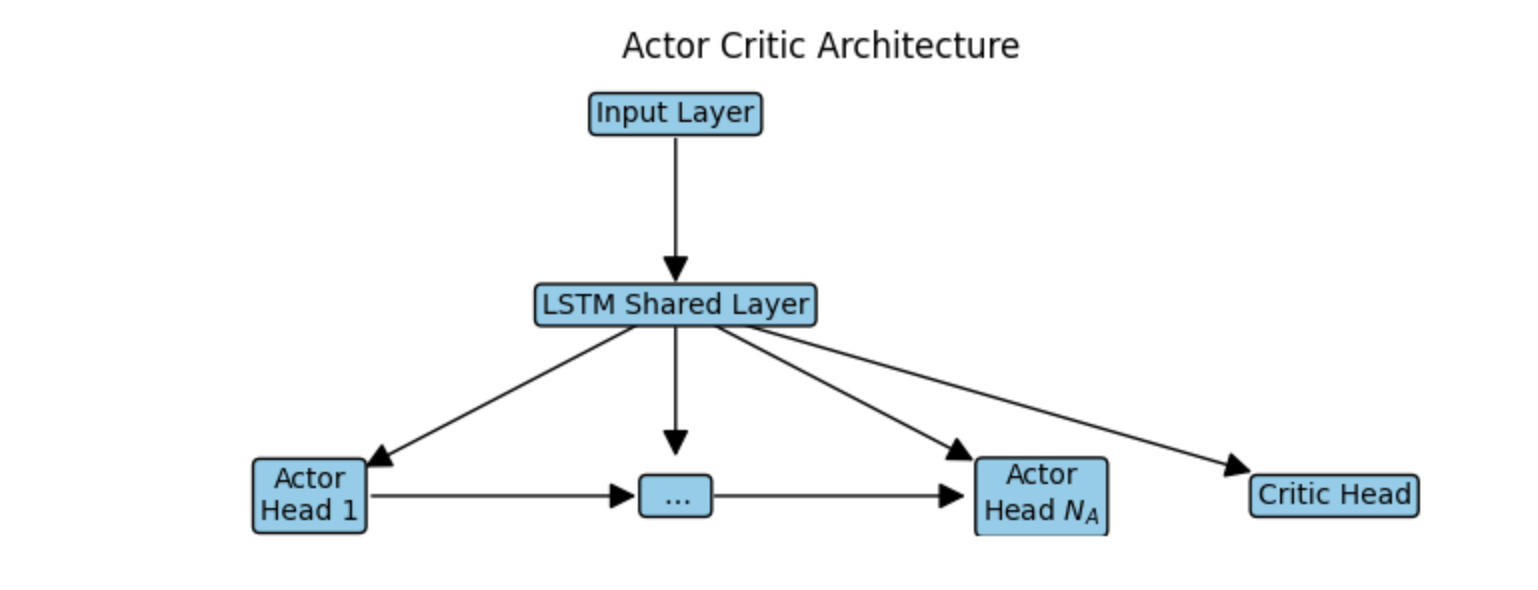
The core of our framework is an Actor-Critic model that learns to construct optimal ensembles of forecasting models. The architecture features a shared LSTM layer that processes embedded representations of model components, multiple actor heads for sampling different architectural elements, and a sophisticated policy network for architecture exploration.
Search Space Design
Comprehensive Model Space
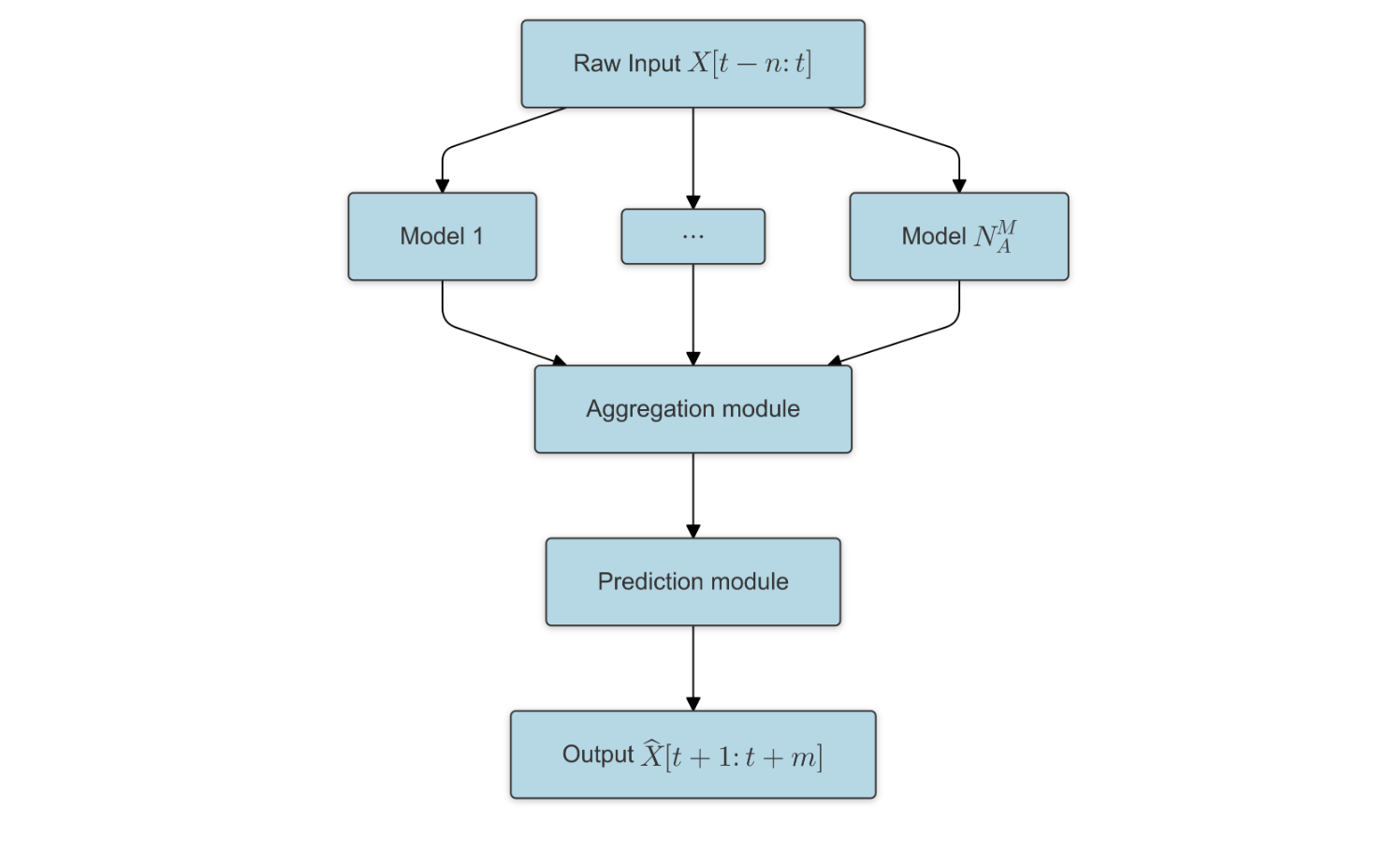
The search space encompasses multiple components: • Variable number of time series modules (NA) • Multiple forecasting model generations • Advanced aggregation modules • Specialized prediction modules Each component is represented in a continuous embedding space, enabling efficient exploration through the Actor-Critic network.
Architecture Sampling
The system employs a sophisticated sampling strategy using multiple actor heads: • Initial sampling of the number of models • Sequential sampling of individual forecasting modules • Selection of aggregation and prediction components Each decision is guided by learned probabilities and maintains exploration capability.
Technical Implementation
LSTM-based Policy Network
The framework utilizes a shared LSTM layer with 128 hidden units to maintain temporal context during architecture sampling. The network processes embedded representations of architecture components and outputs sampling probabilities through multiple specialized actor heads.
Embedding Space
Architecture components are represented in a 20-dimensional embedding space, ensuring unique representations across all dimensions. This continuous representation enables efficient exploration of the discrete architecture space through the Actor-Critic network.
Evaluation Pipeline
The framework includes a comprehensive evaluation system that tracks: • Average architecture probabilities • Component selection distributions • Architecture performance metrics This enables efficient identification of promising architectural patterns.